
SUBSTANTIVELY REVIEWED BY PETER KLAREN · LAST REVIEWED SEPTEMBER 2026 · BASED ON THE WBSO GUIDE 2026
Representative case: this is a representative, anonymised case file based on common WBSO situations — not a literal client file.
Case in twelve phases
1. The company and starting situation
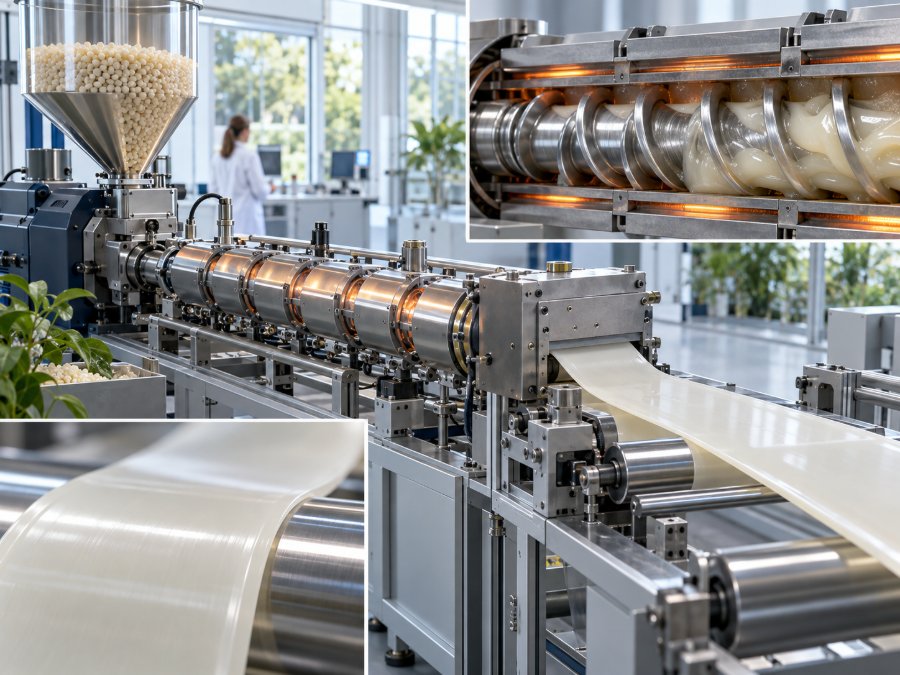
A plastics processor produces film using a bio-based compound. Its order book requires an increase in capacity from 350 to 900 kg/h.
2. The technical objective
Achieve more than twice the production speed while retaining film-thickness tolerance and avoiding thermal degradation of the bio-based material.
3. The technical bottleneck
At higher throughput, melt viscosity shifts unexpectedly and film thickness becomes unstable; local overheating also initiates degradation. Settings from petrochemical practice are unusable because the behaviour is insufficiently understood.
4. Why known technology was insufficient
The existing screw design with standard temperature profiles was systematically tuned. Extensive test series with the existing design also failed to restore a stable operating window: the problem lies in the combination of material behaviour and higher speed, not merely in the settings.
5. Solution directions investigated
(a) New screw geometry with barrier elements for reliable melt formation.
(b) Proprietary temperature zoning with a refined GC temperature profile.
(c) Model-based process control that anticipates and compensates for viscosity shifts.
6. Experiments
Pilot-scale test runs with inline viscometry, DSC analyses of samples, systematic measurement series across the target range, and iterative improvement of geometry and control.
7. Technical result
A stable process window at 850–900 kg/h within the film-thickness tolerance, with degradation below 1%. The new process route was therefore demonstrated at pilot scale.
8. What qualified as S&O
Development of a technically new combination of screw geometry, temperature zoning and process control intended to make the abnormal flow and degradation behaviour of the bio-based material controllable. The experimental test runs and measurements formed part of demonstrating this new process principle.
9. What did not qualify
The increase in capacity as such, construction and installation of the production line, routine quality control and production.
10. More than scaling up?
The WBSO aspect did not lie in increasing capacity itself. At higher throughput, new and technically unexplained material and flow behaviour arose, making known process settings unusable. Solving that technical problem constituted the development work.
11. Where the WBSO project ended
The S&O process ended once the new process principle had been demonstrated at pilot scale. Engineering and implementation of the final production line fell outside it.
12. Appropriate project records
Process logs for each test run, measurement series, screw-design drawings and revisions, material analyses (DSC, viscosity) and research notes.
How this translates into a WBSO application
| Element | Description |
|---|---|
| Technical objective | throughput 350 → 900 kg/h while retaining tolerance and avoiding degradation |
| Technical bottleneck | unstable viscosity and degradation at higher speed; known settings unusable |
| Solution direction | new screw geometry + proprietary zoning + model-based control |
| Technical uncertainty | unknown whether the bio-based compound can be controlled at this speed |
Further reading: WBSO process development · WBSO project records
Does your project resemble this case?
Share your technical bottleneck or research question. We compare your situation with the WBSO criteria and provide an initial substantive assessment.
Discuss my project
More examples
SOURCES AND SUBSTANTIVE REVIEW
RVO — WBSO Guide 2026
Reviewed by Peter Klaren, WBSO specialist since 2004. Last substantively updated: 21 September 2026. This case is representative, anonymised and not a literal client file.